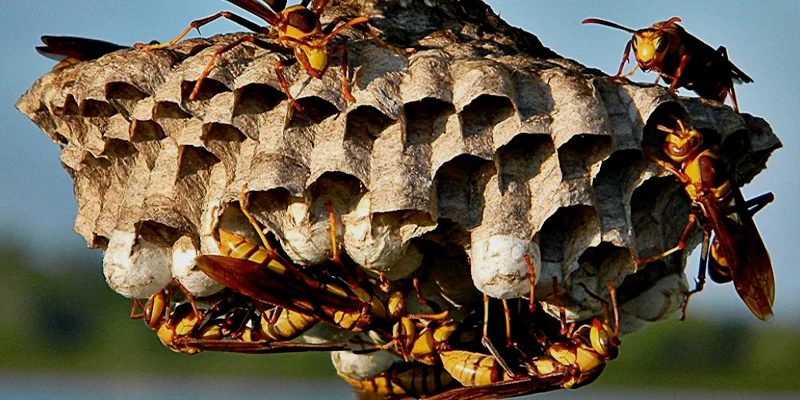
Apiculture (beekeeping) is the raising and care of bees, through which products such as honey, royal jelly, propolis, wax, and pollen are obtained.
Did you know…
Some species of bees can leave the hive if the beekeeper does not treat them well.
The place where all the hives in which the bees live are rescued and concentrated is called the apiary, these are divided into three types of hierarchies, first,
the one that heads everything is the queen bee whose only function is to lay eggs; then, the workers in charge of collecting nectar and pollen; and finally,
there are the drones, who fertilize the queen bee, a curious fact is that once they fulfill their function they are expelled from the colony.
The worker bees are the ones that produce honey, royal jelly, and wax throughout the year, they are also in charge of feeding the hive. Once the bees finish
the process which lasts about three weeks, the beekeepers collect the honey and jelly to obtain other products that can be made, for example, candles, soaps, and creams.
Pollen is exceptionally high in vitamins. It is a source of folate, riboflavin, thiamin, niacin, and pyridoxine, all B-complex vitamins. It also provides vitamins D, E, K, A, inositol, and choline.
Its minerals are phosphorus, calcium, potassium, iodine, zinc, copper, magnesium, and selenium.
The bees collect a material called propolis from the trees, they use it to isolate the entrances of the ants including water to the nest.
Propolis is useful for people who have skin problems, asthma, and other health problems.
Helps prevent and recover from colds and conditions such as sinusitis, otitis, laryngitis, bronchitis, asthma, pneumonia, etc.
Natural anti-inflammatory.
Antiviral effect in the treatment of respiratory diseases.
The bee stings.
The bee sting can certainly cause a risk for people who are allergic, however, the sting for people suffering from health problems such as multiple
sclerosis or arthritis and pain, is very useful for tendonitis and bursitis.
relieves pain and serves as therapy.
Amazing bee ball!
You may have seen this natural phenomenon, which begins as a whirlwind of bees and ends with a ball of live bees hanging from a tree branch or just above any kind of surface.
Here's why it happens.
In the spring, bee colonies grow rapidly, sometimes running out of room for the queen to lay eggs.
Whether they live in a hollow tree or artificial hives, when the queen bee says, "We need more space!" the colony continues. (As it should.)
This movement is called swarming, and bees tend to swarm in the spring. We often get calls from people who have a swarm in their yard
or on a wall in their house or car.
If you see a swarm, enjoy it! Not many people get to witness this phenomenon. And don't be afraid; homeless bees are more docile when they swarm. Their only thought is to protect the queen,
somewhere in that big ball of bees, and they won't attack you as long as you don't attack them. For beekeepers, swarm prevention involves constant monitoring of hives to make sure there is
enough room for eggs, larvae, honey, etc. If things seem tight, a beekeeper places another box on top of the hive. Beekeepers are usually happy to capture swarms;
this means free bees (no pun intended, really) to the apiary and eliminating hassle for the owner.